

Human Milk Storage
- Updated
Prior to Expressing Milk with a Breast Pump
Use the following technique to express milk as cleanly as possible.
- Wash your hands with soap and water. Use hand sanitizer (at least 60% alcohol) if you cannot wash your hands.
- Ensure the pump and pump parts are clean. Discard and replace tubing with milk or mold immediately.
- If you are using a shared pump, wipe the dials, power switches, and surrounding area with a disinfectant wipe.
Containers for Expressed Milk
- Breastmilk storage bags or clean, food-grade containers that are BPA-free may be used to store your expressed milk. Glass or hard plastic bottles with well-fitting lids should be used.
- Label the containers with the date of expression and the infant’s name (if needed for daycare or a hospitalized baby). If mixing milk from different pumping sessions, use the date when the oldest milk was expressed.
- If adding fresh milk to a container of frozen milk, cool the fresh milk first so that it does not melt the frozen milk.
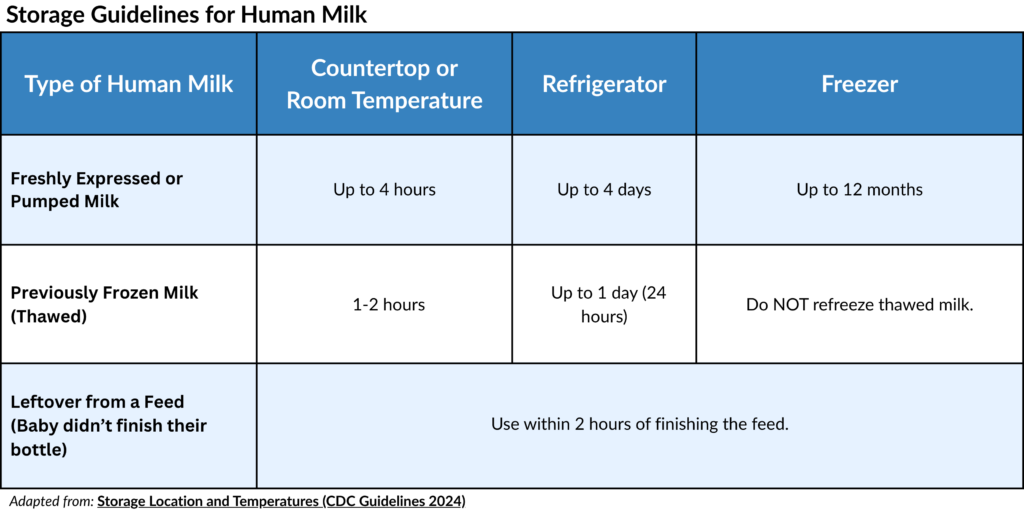
- Milk can be stored in a cooler with ice packs for up to 24 hours when at work or traveling. Use, refrigerate, or freeze the milk as soon as possible once you are at home or reach your destination.
- Freeze fresh milk within 4 days from the date of your milk in amounts that your baby will take in one feeding. This is typically 2-4 ounces (60-120 mL), regardless of age. Freezing in smaller volumes helps to avoid wasting milk due to thawing more than you need.
- Leave 1 inch (~2.5 cm) of space at the top of the container prior to freezing to allow for expansion when freezing.
- Avoid storing milk in the freezer door to protect it from temperature changes due to opening and closing the freezer door.
Safely Thawing Frozen Milk
- Thaw the oldest milk first when you are ready to use it. There are 3 recommended options for thawing the milk:
- In the refrigerator overnight.
- In a container in a warm water bath.
- In a container under running warm water.
- If the milk was frozen in a storage bag, you may want to place it in another container before placing in a warm water bath or under running water, to prevent leakage from tiny punctures in the plastic bag.
- NEVER microwave human milk. This can destroy nutrients in the milk. It can also cause hot spots that can burn your baby’s mouth.
- Once the milk is thawed, use it within 24 hours.
- Once frozen milk is at room temperature, use it within 2 hours.
- Do NOT refreeze human milk.
Common Questions
Why does my milk smell or taste soapy?
Many parents notice that their expressed breastmilk has an off-odor or tastes soapy. All stored milk has a change in odor and taste over time. This is because the enzyme lipase (found naturally in breast milk) breaks down the fats in the milk after the milk has been expressed and is exposed to the air. You may have heard the term “high lipase,” but this is not accurate. Everyone has lipase in their milk, and the odor is not determined by the amount of lipase, but rather by how long the lipase has had the opportunity to do its job, which is breaking down fats.
The longer the milk is stored in the refrigerator or freezer, the stronger the odor may be. The odor is also partially determined by the fats in the lactating parent’s diet. Your milk is perfectly safe for babies to drink even with this change in taste and odor, and it is unusual for infants to be bothered by it. If you think your baby is refusing milk due to taste or odor, it might be helpful to decrease fish intake or withhold fish oil supplements in the lactating parent’s diet. Some people find that adding a few drops of alcohol-free vanilla extract can help make the milk taste better to their baby.
How much milk should I store in the freezer?
If you are exclusively feeding your baby your human milk, you may want to have a small amount of frozen milk stored for times when you may be separated from your baby for more than a few hours. Contrary to what you may see on social media, you do not need to have a freezer full of milk. If you will be going back to work and pumping, you need enough expressed milk for your first day at work, and each day you will express milk for your baby to consume the following day.
Should I feed fresh or frozen milk?
Fresh milk is always preferable to frozen milk. If you have fresh milk, feed that first. If you don’t have any or enough fresh milk, you can use frozen milk, which is preferable to formula. Use the oldest milk first. Most of the nutrients in frozen breast milk remain the same over time, with small decreases seen. Some immune factors (these are live cells and antibodies that help your body fight off infection) decrease over time, making fresh milk more “potent” in its protective qualities. Also, fresh milk contains immune factors that are made in response to the germs you are exposed to in real time, which protect your baby from recent exposure to illness.