


Positioning To Help Your Young Infant Latch Well
- Updated
Young infants have instincts that enable them latch to the breast and feed. However, this does not mean that all young infants will latch well. Positioning your baby and yourself in a way that you are both comfortable will help your infant latch. You may need to experiment to see which positions work the best for you and your infant. A good latch reduces pain, prevents nipple trauma, and helps the baby remove milk well.
General Latching Tips
Try a variety of positions to find the ones that work best for you.
Breastfeeding mothers will choose different positions, and infants might have positioning preferences. There is not one best way to breastfeed! It’s helpful to know a variety of options and try out a few to see what works for you and your infant. You don’t have to figure this out on your own. A lactation specialist can help you learn and practice these positions. There are online videos that show these positions also.

Infants latch better when calm and stable.
Put your baby to your breast when the baby is showing feeding cues, before the baby is overly hungry. Early feeding cues include the baby bringing their hands to their mouths, rooting, sticking their tongue out, and seeming restless. Once a baby is crying due to being overly hungry, latching can be more difficult. If your baby is at that point, place the baby skin to skin for a few moments, or allow the baby to suck on your finger to calm the baby before latching. Continued attempts when a baby is very upset may make the baby less likely to latch well.
Babies don’t like to feel unstable or as if they might fall. A baby who feels unstable is less likely to open their mouth wide or keep their mouth wide while latching. Laid back positioning, allowing the baby to stabilize by planting their feet against your body can help latch. A simple trick to accomplish this in other positions is having your partner put a little pressure against the bottom of the baby’s feet so the baby can push against their hands. Doing this as your baby is starting to latch can help a baby feel stable.
Tummy to tummy positioning.
For most latching positions, it’s best to adjust the baby’s body so they are directly facing you, and the baby’s tummy is right up against your tummy. This ensures that your baby does not need to turn their head to latch, which makes it harder for the baby to open wide and deeply latch.
Try not to push baby’s head forward.
Babies have a reflex to push their heads back if something presses their head forward. While it can seem like this would help a baby get to the breast, it typically accomplishes the opposite. Support your baby’s head behind their ears, at the base of the head, just above the neck.
Position your breast for optimal latching.
There are ways to hold your breast to help latching. Sandwiching your breast can help achieve the asymmetric latch assist with deep latching. If sandwiching, be sure you are doing this in the right direction – so that the longer part of the sandwich is parallel to your baby’s lips. You can also press into the breast on the side where your baby’s upper lip is to point the nipple up towards your baby’s nose. Test out different holds to find what works best for your baby – some babies do better latching to a softer breast, some to a firmer breast.
Aim for an asymmetric latch.
It may seem like your baby should be positioned so that the nipple enters the center of an open mouth. In fact, this tends to promote a shallow, painful latch. Positioning a baby so that the nipple is near the baby’s upper lip and their chin touches the breast causes the baby to open wide. This is called an asymmetric (or “off-center”) latch. When the mouth is open widely, the baby can latch more deeply, leading to a more comfortable and effective nursing experience.
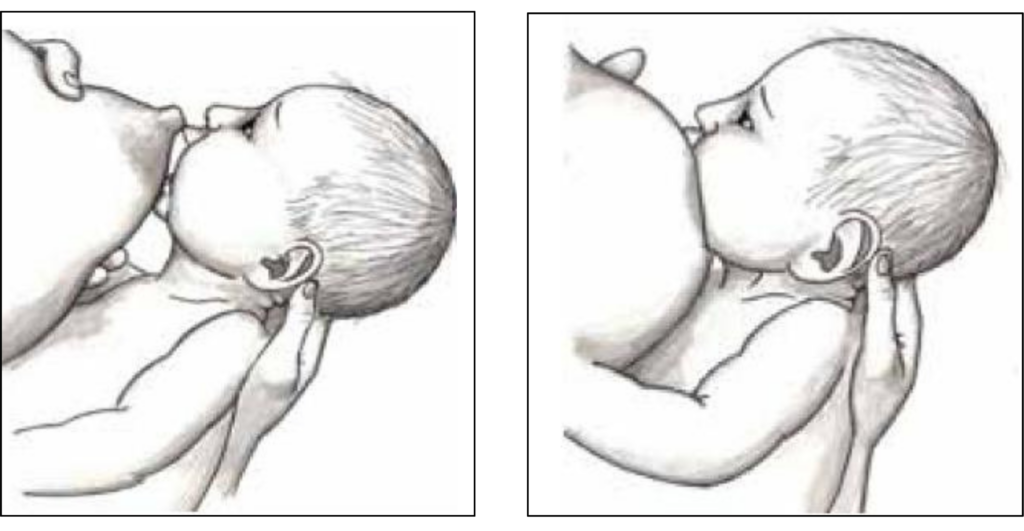
This picture shows an example of the baby’s asymmetric approach to the breast on the left, and how it will look after your baby is latched on the right. Check out IABLE’s video titled Sandwich Hold and Asymmetric Latch for demonstrations of an asymmetric latch.
If your baby won’t latch or latch is too painful:
- It is important to continue removing milk from your breasts regularly so that your body will continue to produce milk.
- Consider pumping or hand expressing milk instead of latching for every feeding to give yourself a break while you and your baby are waiting to be evaluated by a lactation specialist.
- Get hands-on lactation support from a lactation specialist and continue to practice using the tips provided in this handout.